
Mushroom Seller's Legal Guide 2026 | 50 State Cottage Food & Compliance Reference | Sell Dried Mushrooms Legally | Digital PDF Download
$4.99 $9.99
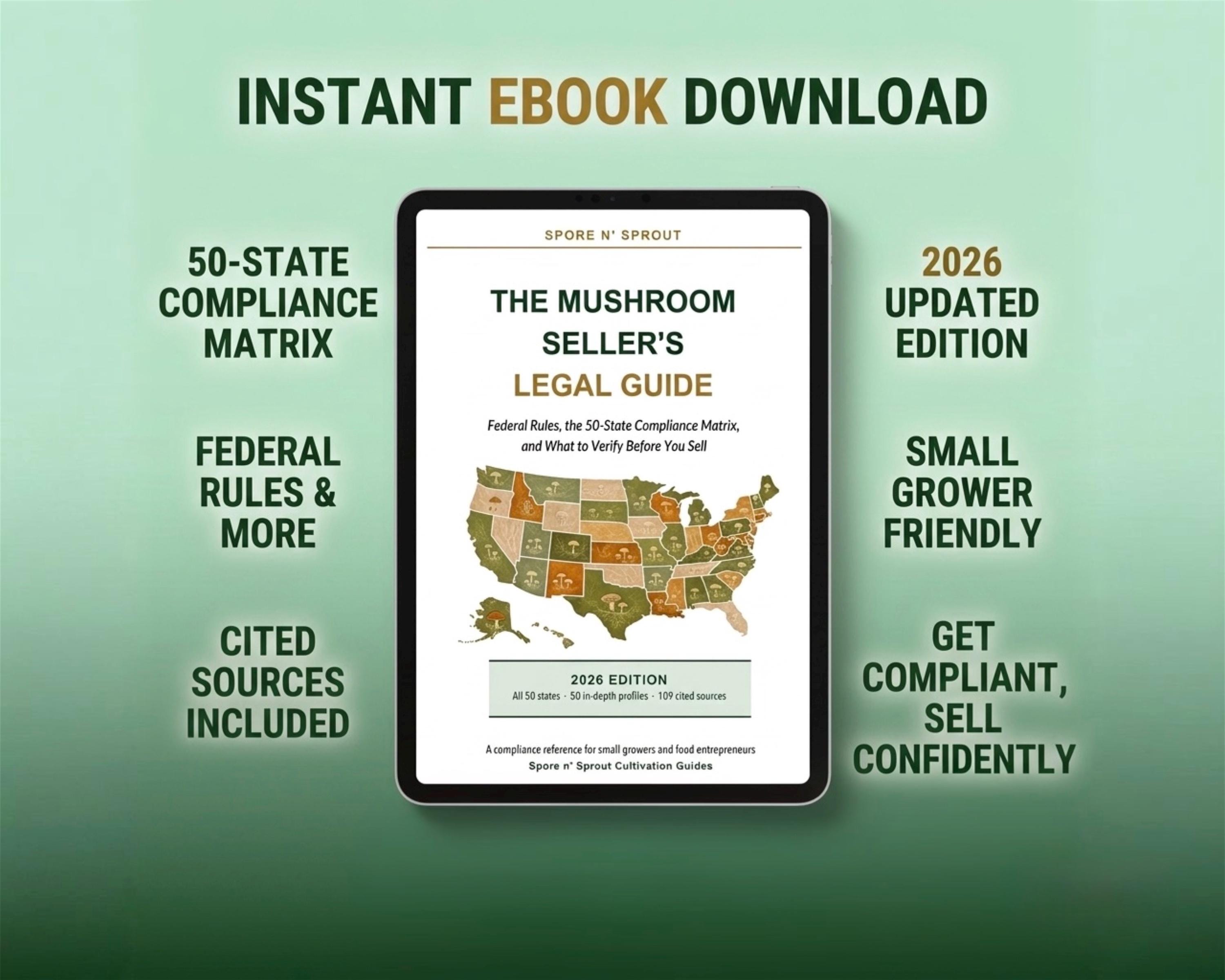
THE MUSHROOM SELLER'S LEGAL GUIDE — 2026 Edition
135 pages · All 50 states · 109 cited government sources
You can grow beautiful mushrooms and still get shut down at the market.
The rules that decide whether you may legally sell what you grow are scattered
across a federal rulebook, fifty separate state codes, and a county health office
that may have its own opinion. Almost none of it is written for a small grower,
and almost none of it is in one place.
This guide puts it in one place.
⬥ THE QUESTION EVERYONE ASKS, ANSWERED FOR ALL 50 STATES
"Can I dry mushrooms at home and sell them where I live?"
Chapter 04b answers exactly that, state by state, in a single table — with the
reason and one concrete next step for every row. No guesswork, no filler.
Four states permit dried mushrooms outright. One permits them only if cultivated.
Twelve close the home route entirely. New Jersey prohibits dried mushrooms by name.
Michigan is the only state that expressly allows dried WILD mushrooms as a cottage
food, if a certified expert handles them.
Most guides never tell you which is which.
⬥ WHAT'S INSIDE
• Start Here — find which of the eight selling lanes you're actually in
• How mushroom law is layered — federal, state and county, and how they stack
• 2026 changes to watch
• The Federal Rulebook — produce safety, food processing, supplements, organic
• Beyond the Home Kitchen — the exact line where you become a food "facility,"
FDA registration, and whether to rent a commercial kitchen
• The 50-State Compliance Matrix
• Can You Sell Dried Mushrooms Where You Live? — the verdict table
• 50 individual state profiles — eight lanes each, with the agency that actually
has authority and a clickable source link
• Labeling and consumer disclosures — the exact warning wording some states require
• Gray areas and who to call first
• Full source index and glossary
⬥ ALCOHOL-BASED TINCTURES GET THEIR OWN LANE
Tinctures are regulated differently from powders and capsules — alcohol brings in
the federal Alcohol and Tobacco Tax and Trade Bureau on top of the FDA, plus your
state alcohol board. That framework is set out and cited to the Code of Federal
Regulations. Several states bar tinctures from the home-kitchen route entirely,
and the guide names them.
⬥ BUILT TO BE TRUSTED, NOT JUST LONG
Every state profile shows where its information came from. 28 states are badged
"Verified to primary sources," meaning each finding was read directly in that
state's own statute or agency publication. The rest say plainly what they are.
Statuses like "Needs Verification" mean exactly that — a prompt to call the
agency, never a guess dressed up as an answer.
Along the way this edition catches things most references still get wrong:
Alaska's sales cap was abolished in 2024, Nevada's statute was repealed and its
regulator changed, Indiana's rules were replaced in July 2026, and Kentucky's
commonly cited section has been superseded.
⬥ DELIVERY
Instant digital download. Because the file is larger than Etsy's direct download
limit, you'll receive a one-page PDF with a secure link and simple instructions.
No Google account needed. Every source link inside the guide is clickable.
⬥ PLEASE READ
This guide is general educational information compiled from published government
sources. It is not legal advice and it is not a substitute for guidance from a
licensed attorney or from the agency that regulates your operation. Food law
changes constantly — always confirm a rule with the authority named in your state
profile before you rely on it.
Digital file. No physical item will be shipped. Due to the nature of digital
downloads, all sales are final.
Digital downloads
Your files will be available to download once payment is confirmed.
Frequently Asked Questions
Care instructions
Liquid culture can be stored at room temperature for up to 6 months and longer than a year if refrigerated. Grain spawn and substrate should be used within 1-2 weeks of being sterilized.
What is the difference between spores and liquid culture?
A liquid culture syringe is a culture medium that contains small pieces of Mycelium which have already germinated (from spores) and began growing. Often a Liquid culture syringe contains a nutritious liquid (often sterilized) such as honey liquid culture which the Mycelium can feed on and expand.
A spore syringe contains spores suspended in a water solution (often sterilized and distilled). Spores can be viewed in a similar way seeds are viewed in a plant’s life cycle. The difference with spores is that two spores that are a genetic match must meet (under the correct conditions) then germinate to begin their life cycle. A spore syringe will create a Mycelium network with many different genetic lineages inside.
How long does it take to colonize grain spawn?
Generally it takes 3-5 days for visible growth. At this point it is best to shake the grain spawn to redistribute the mycelium. After shaking, the mycelium with rebound and colonize the grain spawn fully in 1-2 weeks.